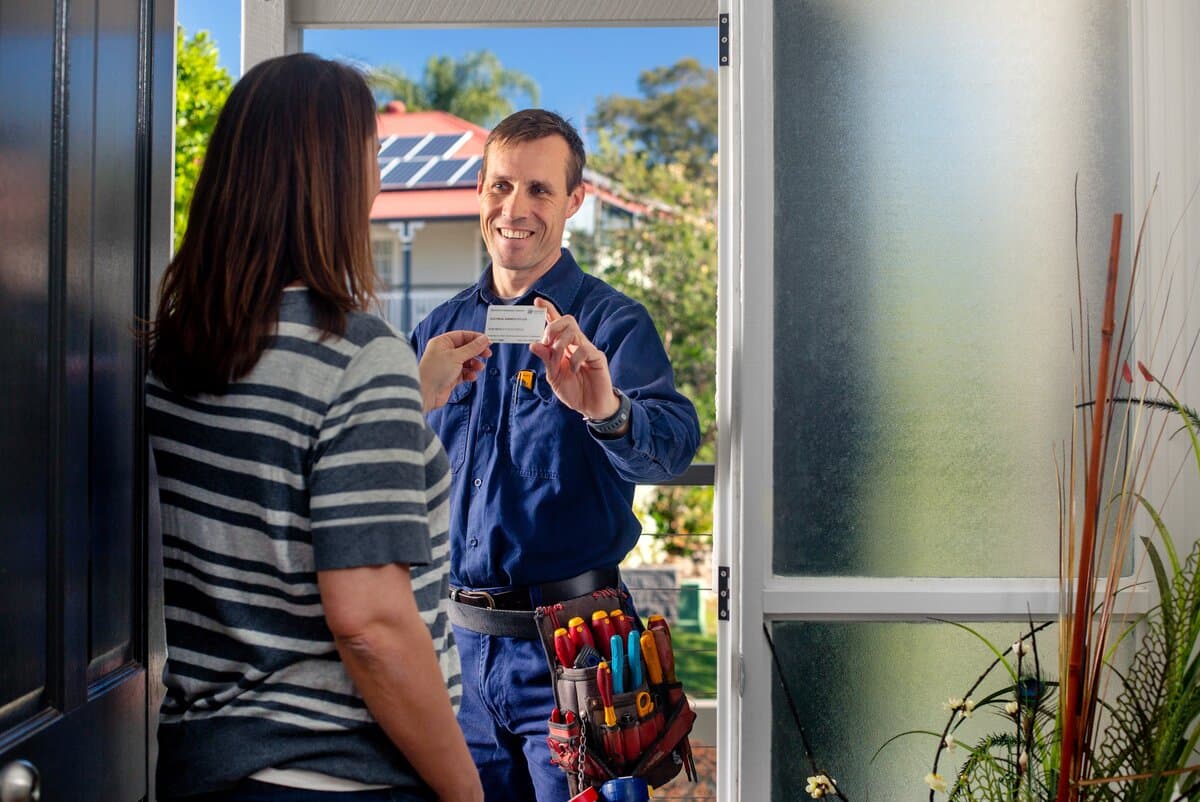
Before planned electrical work, check who is contracting with you, whether the licence covers the work and who will carry it out. A familiar trading name, an ABN or a good review is not a substitute for those checks.
Check the contracting business
Ask for the name and licence number of the entity issuing the quote. Use Service NSW's licence-checking guide and Verify NSW (opens in new tab) to compare the holder, status, authorised work and any conditions with the proposal.
A company contractor licence and an individual's licence or certificate are not interchangeable. A company or partnership contracting for relevant trade work needs the appropriate licence; a worker's qualification alone does not establish that the business holds it. See Service NSW's company contractor guidance (opens in new tab).
If a name or number does not match, ask for clarification before accepting planned work. A failed search can be an identification problem, not proof that someone is unlicensed.
Check who will do the work
Ask who will perform or supervise the electrical work and how to reach the responsible person. NSW distinguishes a contractor licence from a qualified supervisor certificate. Service NSW explains how to check a supervisor's certificate (opens in new tab).
Experience relevant to the job can help you assess the proposal. A newly issued licence is not proof of poor workmanship, just as many years in business are not proof of appropriate authorisation.
Does the job need additional credentials?
Some services involve additional requirements:
- Network connection work: check the relevant Level 2 ASP accreditation and the worker's authorisation for the distributor and work involved.
- Security systems: check the business and operative licensing applicable to the installation or service.
- Plumbing or refrigeration: confirm the appropriately qualified people responsible for those parts of a combined job.
The scope determines what must be checked. A general electrical licence should not be treated as blanket authority for every specialist task. The NSW ASP Scheme (opens in new tab) explains network-connection accreditation.
Confirm insurance separately
Ask for current evidence appropriate to the work, such as a certificate of currency. Check the insured entity, period and relevant scope. A licence does not prove insurance cover, and an insurance document does not replace the licence.
For a commercial site, compare the proposed cover with any requirements in the lease or project documents rather than assuming one amount suits every job.
Ask how the job will be handled
Useful questions include:
- What is included in the proposed work, and what remains subject to assessment?
- Is the price fixed or based on time and materials?
- What does an attendance or fault-finding charge cover?
- What power interruption and access are expected?
- What testing and completion records will be supplied?
- How will extra work and follow-up faults be handled?
Planned work should have a clear written scope. An urgent fault may need immediate assessment or safety work before the full repair scope is known.
Use reviews as supporting information
Reviews can describe communication or a customer's experience of a similar job. They cannot verify a licence, concealed workmanship or the cause of a technical problem.
Read across several sources and look for relevant, consistent information. Do not assume a review is genuine because it is long or names a suburb, or dismiss a capable business solely because it has fewer reviews.
What to note before you call
Have a short description of the work ready: the rooms or equipment involved, what you want changed or what has failed, and whether the job is part of a renovation or other building work. Note anything that affects access, such as a shared switchboard, a tenancy or a strata scheme, because the electrician may need permission from someone other than you before work can proceed.
Keep your own record of who you spoke to, the trading name on the quote and the date. If the job later needs a follow-up visit or you need to locate the compliance certificate, those details make it straightforward to identify which business did the work.
Common misunderstandings
A licence on the van proves the business is licensed. Vehicle signage, a website and a uniform show a trading name, not a licence status. The register is the check.
A licensed electrician can do any electrical job. Ordinary wiring work and network connection work are covered by different authorisations. Ask specifically when the work touches the service line, the meter or the point of supply.
The certificate is optional for small jobs. In NSW, installation, repair and alteration work requires electrical compliance documentation, including relevant like-for-like replacements. Ask when it will be supplied and keep it with the property records.
A quick quote from a photo is the same as an assessment. A photo can help describe a planned job, but it cannot show the condition of wiring, the load on a circuit or what is behind a cover. Planned work is quoted in writing once the scope is understood, which sometimes means a visit first.
Arranging electrical work
AB Electrical handles home electrical work, switchboard work and urgent faults. For planned work, send a short description and ask for the details needed to assess the proposal.
For fire or immediate danger, call 000 first. Do not delay emergency assistance while comparing contractors.
For an urgent fault, call 0405 343 343 from a safe place. For planned work, send an enquiry with the suburb, a short description of the job, and photos only if they can be taken safely without opening covers. The same electrician handles the work from the first call to completion.