Test and tag is one of those compliance items that quietly determines whether a Central Coast business is meeting its workplace safety obligations — and whether it has a defensible paper trail if something goes wrong. It's also one of the most misunderstood. Some businesses test and tag everything every six months because they were told they had to. Others have never done it because they don't know they should. The truth, as usual, sits in the middle. This guide explains what test and tag actually is, what's required for Central Coast businesses, how often to do it, and how to get it set up cleanly.
If you need a Central Coast commercial electrician to set up a scheduled test-and-tag program for your business — office, retail, hospitality, strata, or small industrial — AB Electrical handles annual or six-monthly programs with full register, individual tags, and compliance certificate.
What test and tag actually is
Test and tag is the routine inspection and electrical testing of portable electrical equipment — anything with a flexible plug-in cord that can be moved around. This includes:
- Computers, monitors, printers, and office equipment
- Kitchen appliances (microwaves, kettles, toasters, fridges with plug-in cords)
- Power tools and shop equipment
- Lamps, fans, and portable heaters
- Extension leads and power boards
- Vacuum cleaners and cleaning equipment
- Phone chargers and laptop power supplies (technically yes, though usually low-priority)
It is not the same as fixed electrical wiring inspection, which covers the wiring built into the walls and circuits. Test and tag specifically targets the portable equipment that workers and customers come into contact with day-to-day.
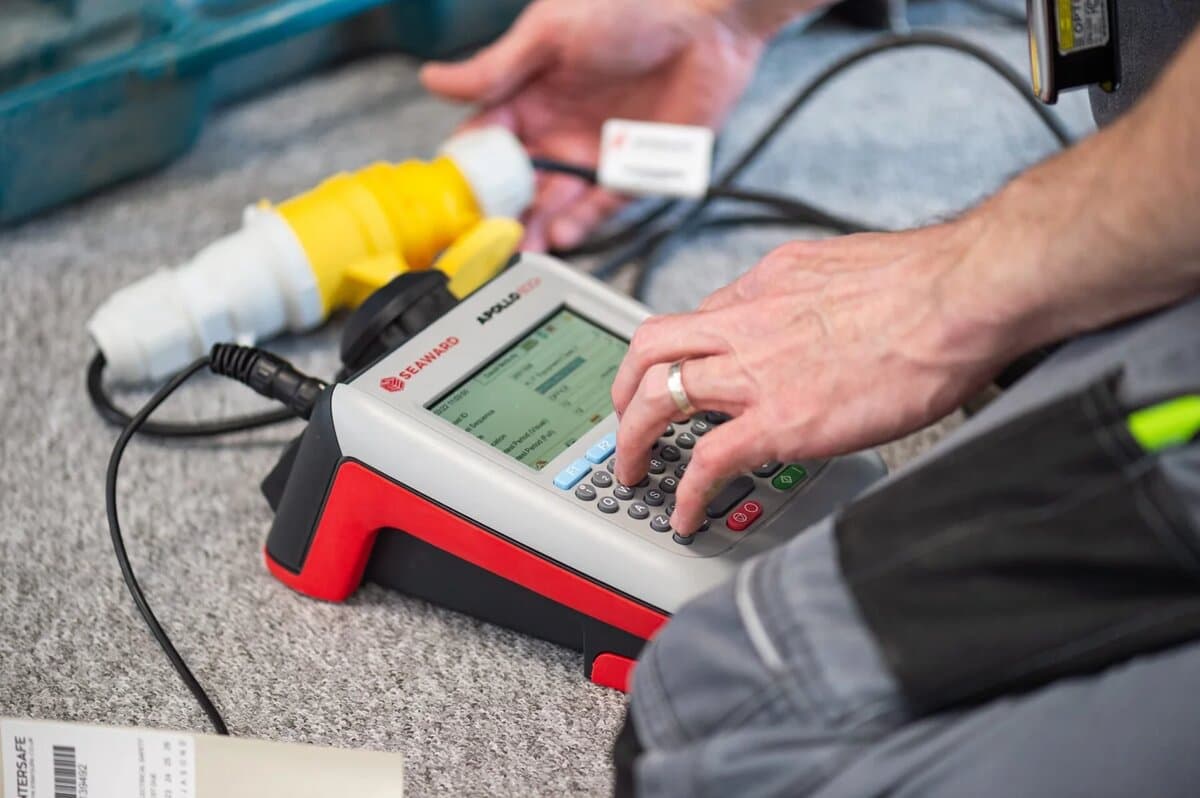
The "test" part is an electrical test using a portable appliance tester (PAT) that checks earth continuity, insulation resistance, and polarity. The "tag" part is a small label attached to the equipment showing the test date, the next test due date, and the technician who performed the test.
Is test and tag legally required for businesses in NSW?
The answer is nuanced and worth getting right.
It is not a strict legal requirement for every business in NSW the way smoke alarm compliance is for residential rentals. There is no NSW law that says "every office must test and tag every twelve months."
It is a workplace safety obligation under the Work Health and Safety (WHS) Act 2011. Employers have a duty to provide a safe workplace, including ensuring that electrical equipment is safe to use. Test and tag is the most common way to demonstrate that this duty has been met. If a worker is electrocuted or a fire is caused by faulty equipment that has never been tested, the employer is in a much weaker position legally.
It is required by AS/NZS 3760 — the Australian standard for in-service safety inspection and testing of electrical equipment. AS/NZS 3760 sets out testing intervals based on the environment (more frequent in harsh environments, less frequent in benign offices).
It is often required by insurance policies — many commercial insurers require evidence of test and tag in order to honour a claim related to electrical fault, fire, or injury. This is the strongest practical reason most Central Coast businesses do it.
It is required for many leases — particularly in shopping centres, strata commercial buildings, and managed retail premises, where the lease specifies that all portable equipment must be test-and-tagged on a regular schedule.
It is required for hospitality — health and safety inspections for cafes, restaurants, and food businesses on the Central Coast often check test-and-tag records as part of the inspection.
So while there is no single "you must test and tag every X months by law" rule, in practice every business with employees, customers, equipment, an insurance policy, or a commercial lease has multiple overlapping reasons to do it.
How often should each environment be tested?
AS/NZS 3760 recommends different intervals based on the environment:
| Environment | Testing interval |
|---|---|
| Office, low-risk | Every 5 years (sometimes 12 months in practice for record-keeping) |
| Retail and customer-facing | Every 12 months |
| Hospitality kitchens | Every 12 months (sometimes 6 months for high-use equipment) |
| Construction sites | Every 3 months |
| Workshops and small industrial | Every 12 months |
| Schools, gyms, and high-traffic public areas | Every 12 months |
| Equipment hire | Every 3 months or before each hire |
| Medical and aged-care facilities | Every 12 months (often more frequent for life-critical equipment) |
The 5-year interval for low-risk offices is technically permissible under the standard but rarely used in practice — most insurers and most facility managers prefer annual testing because it demonstrates active management and produces a more current record.
What a test-and-tag visit covers
A typical commercial test-and-tag visit has the following stages:
- Visual inspection — checking the equipment for damage, frayed cords, cracked plugs, broken switches, missing covers, and obvious wear. A surprising number of items fail at the visual stage and never need to be plugged into the tester.
- Earth continuity test — confirming that the protective earth on the appliance actually connects to the earth pin on the plug.
- Insulation resistance test — confirming that the insulation around the conductors is intact and not breaking down.
- Polarity test — confirming the active and neutral wires are not swapped.
- Tag application — a small label attached to each item showing test date, next test due date, technician, and unique ID.
- Register entry — each item is logged in a register with its unique ID, location, test result, and any notes.
- Compliance certificate — issued at the end of the visit, listing all tested items and the overall site result.
- Failure handling — any items that fail are removed from service, tagged out, and listed separately for the business owner to repair or replace.
The whole process for a typical small office (15-30 items) takes 1-2 hours. A larger site (50-150 items) might take half a day. A hospitality kitchen with heavy equipment might take half a day or longer.
What it costs on the Central Coast
Realistic Central Coast pricing for test-and-tag in 2026:
- Small office (typical 15-30 items): $280–$640 per visit, annual or six-monthly
- Retail shop (typical 20-50 items): $380–$780 per visit
- Hospitality kitchen (typical 30-80 items): $580–$1,200 per visit
- Small industrial / workshop (typical 50-150 items): $780–$1,800 per visit
- Multi-site or franchise group: per-visit pricing reduces with scale; consolidated invoicing available
Setup costs for first visit are slightly higher than recurring visits because the initial register has to be built. Subsequent visits are quicker and cheaper because the register and labels are already in place — only changes (new equipment, removed equipment, failures) need to be processed.
What to do with the failures
A typical test-and-tag visit finds 3-8% of items failing in the first year, dropping to 1-3% in subsequent years (because the obvious fails get removed and replaced after the first round). Failed items have three outcomes:
- Remove from service permanently — old equipment that's not worth repairing
- Repair and re-test — usually a worn cord, broken plug, or cracked casing that can be fixed inexpensively
- Send to manufacturer warranty — if the item is still under warranty
A good test-and-tag electrician will give you a clear list of failures with a recommendation for each item.
Common mistakes Central Coast businesses make
A few patterns that come up regularly:
- Testing once and never again. A single test-and-tag visit is not "compliance" — it has to be a recurring program with up-to-date records.
- Losing the register. The whole point is the paper trail. If the register is lost, the next visit has to start from scratch.
- Testing things that don't need it. Fixed wiring, hardwired equipment, and items that can't be moved are not portable equipment and don't need tagging — they need a separate fixed-wiring inspection.
- Hiring an unlicensed test-and-tag operator. Test and tag does not require a full electrical contractor licence, but it does require training and competency. Hiring a "tag and bag" operator who doesn't actually understand the test results creates a register that looks compliant but isn't.
- Not removing failed equipment from service. A failed item that stays in use because the manager didn't read the failure list is the worst possible outcome — there's now documented evidence the business knew the item was unsafe and used it anyway.
How AB Electrical sets up test-and-tag programs on the Central Coast
AB Electrical handles test-and-tag as part of regular commercial work for Central Coast businesses. The standard pattern:
- Initial walkthrough to count items, identify the environment, and agree on testing interval (usually annual)
- First-visit register build — every item logged, tagged, and tested
- Compliance certificate issued the same day
- Recurring visits scheduled — annual or six-monthly depending on environment
- Failure list supplied with each visit, plus quotes for repair or replacement of failed items
- Account terms available for ongoing customers, with consolidated invoicing for multi-site clients
The whole program is set up so the business can hand the certificate to the insurer, the inspector, the auditor, or the lease manager without scrambling.
What to do next
If your Central Coast business needs test-and-tag set up — for the first time, or because the previous program lapsed — contact AB Electrical with the site address, the type of premises, and an approximate count of portable electrical equipment. We will reply with a written proposal, an indicative timeline for the first visit, and a recurring schedule.
For more on commercial electrical work, see the Central Coast commercial electrician page.
Related Articles
Emergency Lighting and Exit Light Compliance in NSW — What Every Building Owner Needs to Know
A guide to emergency lighting and exit-sign compliance for Central Coast commercial buildings — what NSW and AS/NZS 2293 require, who is responsible, how often testing is needed, what a typical inspection covers, and what it costs.

How to Choose a Commercial Electrician for a Cafe, Retail, or Office Fit-Out
A practical guide for Central Coast business owners and project managers planning a fit-out — what to ask a commercial electrician before hiring, what to look for in a fit-out quote, what compliance certificates should be supplied, and the red flags that lead to mid-build problems.
How to Find a Licensed Electrician (Checklist)
A practical checklist for verifying a licensed electrician — licence lookup, insurance checks, questions to ask, and red flags to walk away from.