
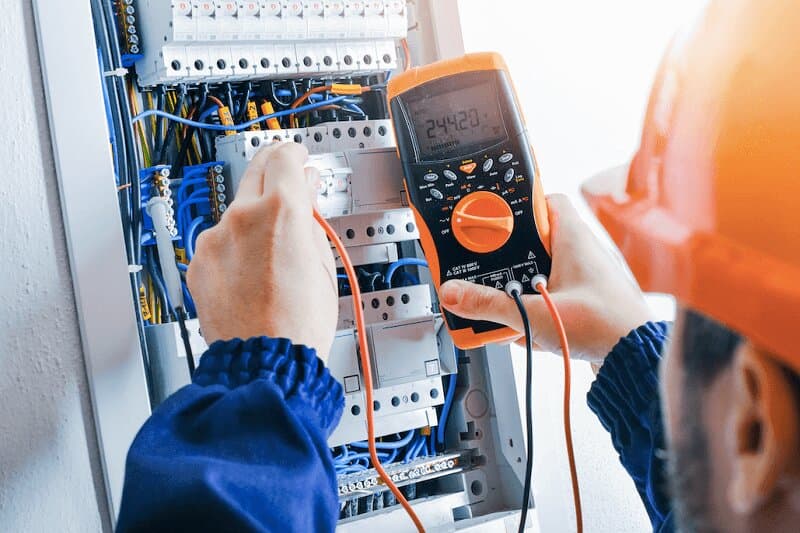
Electrician costs on the Central Coast typically range from a standard call-out fee for simple jobs like replacing a powerpoint, through to larger quotes for switchboard upgrades, rewiring, or emergency after-hours work. The final price depends on what needs doing, how long it takes, what parts are involved, and whether the job is urgent.
Rather than focusing only on the hourly rate, it helps to understand what shapes the total cost so you can compare quotes properly and avoid surprises once the electrician arrives.
What changes the price
Electrician pricing is usually shaped by a few practical factors:
- The type of job, such as powerpoints, lighting, switchboards, or emergency electrician work.
- The time required to diagnose the problem, especially when the issue is intermittent or hidden behind walls.
- Access to the fault location, including roof spaces, switchboards behind furniture, ceiling cavities, or external fittings at height.
- Whether materials are standard replacement parts or more specialised components that need sourcing.
- Whether the job is urgent and needs same-day or after-hours attention, which attracts a higher rate.
- The condition of existing wiring. Older properties can take longer because the electrician may need to bring circuits up to current standards before completing the original job.
Common job types and what to expect
To give you a rough sense of scale:
- Powerpoint installation or replacement is one of the simpler jobs. The cost depends on how many outlets are needed and whether new wiring needs to be run.
- Lighting upgrades vary widely. Replacing a few fittings is straightforward, but a full LED downlight installation with dimmer wiring and ceiling work costs more.
- Switchboard upgrades are a larger job. The board itself, safety switches, circuit breakers, and any wiring corrections all factor in. Most residential switchboard upgrades take 3 to 5 hours.
- Emergency call-outs attract a premium for after-hours, weekend, or same-day response. The trade-off is that the fault gets addressed before it causes damage or becomes dangerous.
- Fault finding is often the least predictable cost. The electrician may need to test multiple circuits, inspect wiring behind walls, or isolate intermittent problems that do not present consistently.
The jobs that usually cost more
Work tends to cost more when it includes one or more of these conditions:
- There is an active fault and the electrician has to diagnose the cause before fixing it.
- The property has older wiring or an outdated board that needs extra time to make safe.
- The issue affects multiple circuits or a larger area of the home or business.
- The job requires a specialist such as a level 2 electrician for mains, metering, or supply-side work.
- The work is urgent and cannot wait for a scheduled booking.
- Asbestos is present in the switchboard backing or meter panel, which requires careful handling.
How to compare quotes properly
If you want to compare electricians on the Central Coast, ask each one the same core questions:
- What is included in the call-out fee? Does it cover the first hour of work, or is it just for showing up?
- Is fault finding billed separately from the repair?
- Are materials included in the quote or added later?
- Is the work being done as a repair, a replacement, or an upgrade? These have different scopes.
- If the fault is more complex than expected, how will additional costs be communicated?
- Is the quote fixed-price or time-and-materials?
That approach is more useful than comparing a single headline number. A quote that includes fault finding, parts, and a compliance certificate is different from one that only covers labour.
When the cheapest quote is not the best value
A low quote can be a good quote, but it can also hide exclusions, limited troubleshooting, or a repair that only solves part of the issue. Common examples include:
- A powerpoint replacement that does not address the faulty wiring behind it.
- A switchboard repair that skips safety switch installation because it was not included in the original scope.
- Emergency work quoted without after-hours rates, then adjusted on arrival.
If the job involves a safety issue, repeated tripping, smoke alarm problems, or a burning smell at a powerpoint, the goal should be a correct and safe fix first. It makes more sense to look at the value of getting the issue sorted properly than to focus only on the lowest number.
How to get a clearer quote faster
The more detail you include in your enquiry, the more accurate the initial response will be. Useful details include:
- The suburb and property type (house, unit, commercial).
- A short description of the problem or the work you need.
- Photos of the switchboard, the affected fitting, or the area where work is needed.
- Whether the issue is urgent or can be scheduled.
- Any relevant history, such as recent renovations or previous electrical work.
What to do next
If you need a straightforward quote, send the suburb, a short description of the issue, and a photo if it helps. If the problem is urgent, call AB Electrical directly so the job can be triaged and scheduled properly.
Related Articles

7 Ways to Reduce Your Electricity Bill with Smarter Electrical Upgrades
Reduce energy waste with practical lighting, appliance, and electrical upgrade decisions that improve efficiency without guessing.
Are LED Lighting Upgrades Worth the Cost?
A practical look at where LED upgrades make the biggest difference and how to think about upfront cost, longevity, and day-to-day usability.
When a Switchboard Upgrade Is Worth Doing
Understand the signs that a switchboard may be outdated, overloaded, or no longer suited to the way the property is used.